Benefactor
$297+
Covers your place and sponsors a scholarship for someone who needs it.

Ten nights with the “Song of the Goddess.” Study Śākta Tantrik teachings on cosmology, yoga and devotion, and join a daily practice of recitation, visualization and journaling anchored in mantra meditation.
10 live sessions · October 11–20, 2026 · 9am ET
Live on Zoom with Jacob Kyle and Tova Olsson. Recordings within 24 hours.
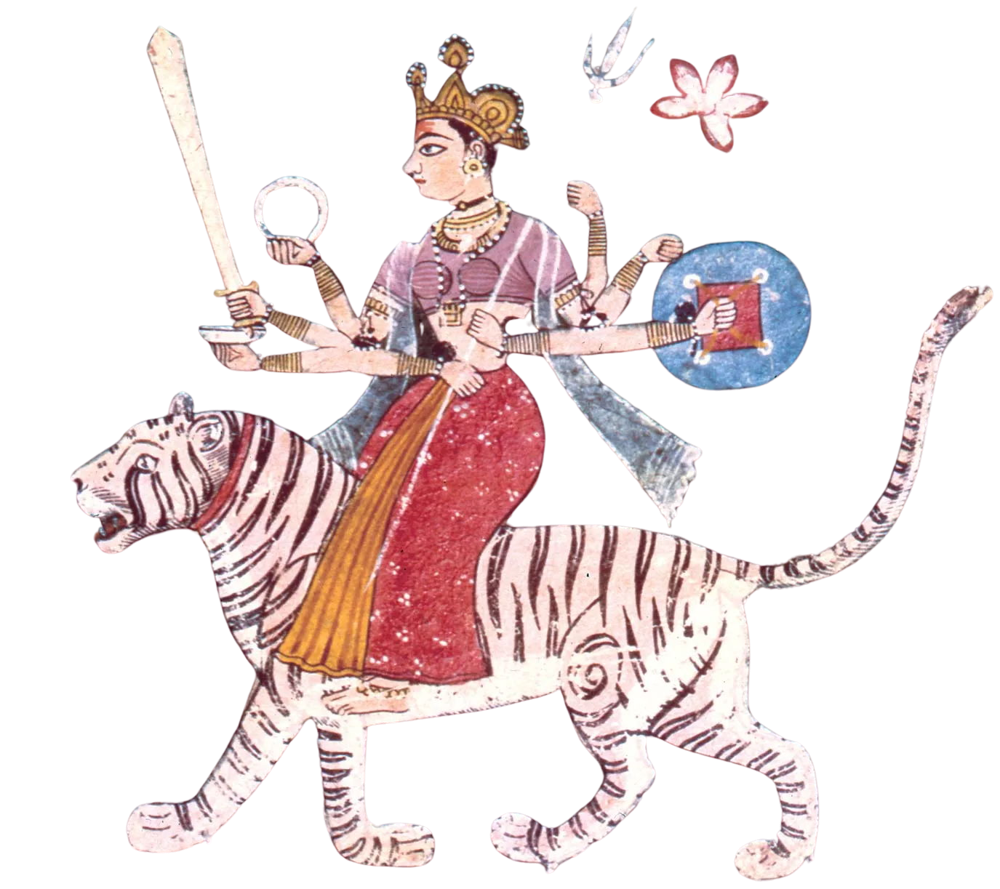
Most yoga practitioners and students of South Asian philosophy know the Bhagavad Gītā, the “Song of the Lord.” Fewer know the Devī Gītā, the “Song of the Goddess.”
Yet it may be the more relevant text for many of us, especially devotees of the Goddess and those drawn to a non-dual Tantrik worldview. Some Śāktas even regard it as the supreme scripture, one that both complements and completes all others.
Join us this Navarātri, and immerse yourself in the wisdom of the Goddess.
One chapter each night. Our sādhana opens on Ghaṭasthāpana, the morning the Kalaśa is established and the Goddess is invoked into the vessel, and closes on Vijayadaśamī, the day of visarjana.
Daily, October 11–20, at 9am ET on Zoom. About 60 minutes each, recorded for anyone who can’t attend live.
The ten chapters of the Devī Gītā, read in step with the ten days of the festival, from her appearance to her disappearance.
Teaching alongside a daily process of recitation, visualization and journaling, anchored in mantra meditation on Hrīṃ.
Written around the thirteenth century, seemingly modelled on the Bhagavad Gītā, and drawing on several philosophical systems (darśana), the Devī Gītā sings the praise of a Goddess who is subservient to none.
Like the Bhagavad Gītā, it is part of a much longer work, though it often circulates on its own. Its 507 verses form the last ten chapters of the seventh book of the Devī-Bhāgavata Purāṇa, one of the most important Purāṇic texts of the Śāktas.
The text opens in the traditional setting of the conflict between gods and demons. The Goddess appears to console the gods, defeated by the demon Tāraka, and to restore them to their celestial realms. Yet the battle itself, unlike in earlier Śākta texts such as the Devī Māhātmya, is given very little room. Its real focus is devotional, philosophical and spiritual counsel, apart from any cosmic or social crisis.
Just as Kṛṣṇa offers Arjuna his wisdom more than his strength in battle, so too the Goddess offers her wisdom teachings to her devotee, the Mountain King Himālaya.
Chapter 10 ends with the Devī dismissed from the external image, led back into the lotus of the heart, and then vanishing from sight: the same gesture the whole subcontinent performs as the images go to the water. We read her disappearance on the day she disappears.
Jacob and Tova alternate leading each night, and open and close the cycle together.
Opening mantras. Jacob on the gītā as a genre; Tova on the story of Śiva and Satī that the text alludes to.
With Jacob & TovaShe appears as unbearable light, then as four-armed Bhuvaneśvarī. Two kinds of seeking in one assembly: the gods want their heavens back, Himālaya wants to know what she is.
With TovaTwo models of creation held side by side: Sāṃkhyan unfolding and Advaitin reflection. Māyā as the power she wields and, in some sense, is.
With Jacob“I am the sun and the stars.” Her self-predications give way to the devouring, fire-spewing form before which the gods faint.
With TovaHearing, reflecting, meditating. Tat tvam asi in her voice, and her own dissolution meditation on the syllable Hrīṃ.
With JacobThe subtle body, the cakras, the ascent, and the descent that matters just as much, in which the body is remade as divine.
With TovaThe archer’s bow, the light beyond all lights, and why the teacher outranks the parent.
With JacobFour grades of bhakti, and the paradox at the summit: utter detachment alongside tears, faltering voice, and dancing without shame.
With TovaSthānas, not tīrthas: her seats are dwellings in this world, each one a place where her body fell. Then the typology of pūjā, and worship turning inward.
With JacobThe throne installed in your own body, its legs the corpses of the gods. She is welcomed, served, and released, led home to the heart, and gone. Closing recitation and visarjana.
With Tova & JacobIts narrative frame, its ten-chapter architecture, and its place among the gītā literature of South Asia.
The Goddess’s own seed-syllable, encountered as sonic essence, meditative object, and ritual thread running through every day of the cycle.
From the benevolent, four-armed Bhuvaneśvarī to the world-devouring Virāj, and sit with the question of how they all express the same divine absolute.
The yoga of knowledge, the eight-limbed and serpentine disciplines, and the paths of devotion, as she herself teaches them.
How “the Goddess is the world” differs from both illusionism and pantheism, and what that difference asks of a practitioner.
A Tantric mode of practice through mantra meditation, always returning to an experiential sense of Devī flowering from the lotus of your heart.
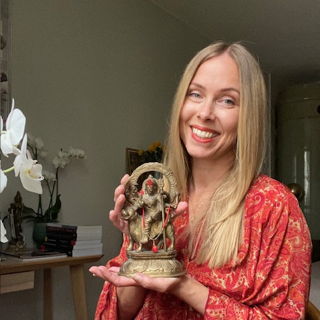
Founding Director, Embodied Philosophy
Meditation teacher, writer, philosophy educator, and Founding Director of Embodied Philosophy. His guiding mission is to re-imagine the modern role of the yoga teacher in alignment with the teachings, texts and traditions of yoga’s profound history.
Jacob is a doctoral student at the University of Oxford, researching Pratyabhijñā philosophy with Diwakar Acharya and Monima Chadha. He holds an MPhil in Classical Indian Religions from Oxford, an MA in Philosophy from the New School for Social Research, and an MSc in Political Theory from the London School of Economics, and is a devoted practitioner of the Śaiva-Śākta darśana.

Founder, Saraswati Studies
A scholar of religion, author and yoga teacher with over twenty years of experience in education, loved for her deep knowledge, her gift for making esoteric ideas accessible, her immersive storytelling, and her heart-led teaching.
Tova holds an MA in Religious Studies and is completing a PhD on the construction of gender in contemporary tantra in Europe. She is the author of Yoga and Tantra: History, Philosophy and Mythology (Motilal Banarsidass), runs the online school Saraswati Studies, and teaches on several international yoga teacher trainings.
This many hours of study and practice would usually be priced at $197. We offer it by donation so that everyone who wants to can take part. If you’re in a more fluid financial position, you can help subsidize those who aren’t. No one is turned away for lack of funds.
Covers your place and sponsors a scholarship for someone who needs it.
Supports the teachings and keeps the container open to all.
A meaningful offering that honors the exchange.
Pay what you can, from $1. Your presence and participation is the offering.
You’ll enter your amount at checkout. Every offering receives the full program.
Refund requests within 30 days are fully honored.
Not at all. Every Sanskrit term is translated and explained, and we read the text together one chapter at a time. Newcomers and long-time students of the Goddess traditions will each find a depth that suits them.
Every session is recorded and available within 24 hours, so you can follow along at your own pace. Joining after the festival has begun? You can catch up on the recordings and join the rest live.
Daily from Sunday, October 11 to Tuesday, October 20, 2026, at 9am ET, live on Zoom. Each session runs about 60 minutes.
Choose the amount that fits your situation. The tiers are a guide: larger offerings quietly fund scholarships for those who need them, and no one is turned away for lack of funds. Everyone receives the same program.
Refund requests made within 30 days of purchase are fully honored. Write to hello@embodiedphilosophy.com and we’ll issue your refund within 5 business days.
oṃ hrīṃ
Deepen your connection to the Devī and invite her wisdom into your daily life.
Reserve your place